

For years, EMRs (Electronic Medical Records) have been viewed as necessary but limited tools, a place to record visits, upload consents, check schedules or print reports.
That phase is coming to an end.
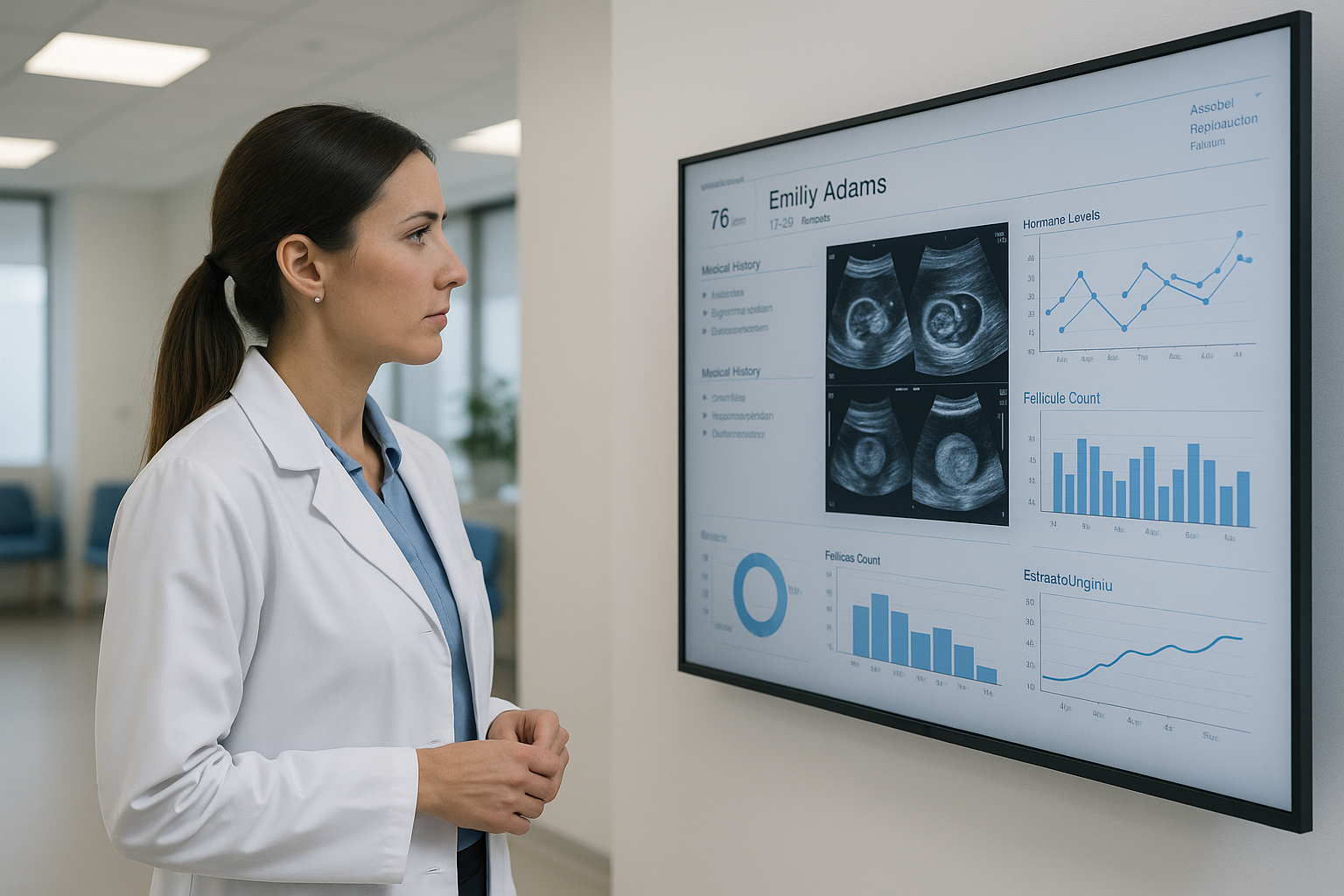
The powerful combination of AI, real interoperability and enriched clinical data is turning EMRs into intelligent platforms capable of coordinating, analysing, executing, predicting and learning.
And this won’t just modernise fertility clinics, it will fundamentally change how doctors, embryologists, admin teams and clinic leadership work every day.
This post isn’t about theory.
It’s about how AI will transform daily operations in a fertility clinic and what this shift means for the next five years.
1. From a “system” to an intelligent clinical management platform
Most EMRs today function as simple repositories:
- They receive information.
- They organise it.
- They display it when someone goes looking for it.
The near future will be the opposite: systems that act before the user even needs to request anything.
This means EMRs that:
- Detect inconsistencies in treatment plans before they reach the patient.
- Predict bottlenecks in the operating room, the IVF lab or daily schedules.
- Automatically prioritise tasks based on real clinical risk.
- Create dynamic workflows tailored to each patient’s profile.
In other words: the EMR will stop being a digital archive and become the central layer that connects and drives every process in the clinic.
2. AI won’t be an “add-on”; it will become the engine behind clinical and operational decisions
We talk a lot about generative AI, but the real transformation will come from operational and analytical AI, fully embedded in the clinic’s platform.
Areas where its impact will be immediate:
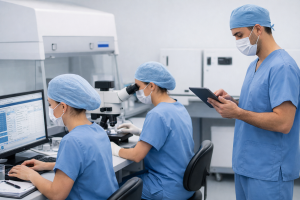
IVF Laboratory
AI will:
- Automatically identify anomalies in fertilisation or embryo development.
- Label time-lapse events without human intervention.
- Suggest decisions based on large multicentre datasets.
- Predict personalised success rates for each patient.
Medical Consultations
AI will help:
- Generate visit reports automatically with all relevant clinical context.
- Suggest medication adjustments based on history and previous response.
- Detect clinical risks that may not be obvious at first glance.
Management and Clinic Leadership
AI will be able to:
- Predict patient demand.
- Simulate lab capacity based on workload and available staff.
- Automatically calculate the financial impact of protocol changes.
The key shift: AI will no longer live in a standalone module, it will become part of every decision made across the clinic.
3. Interoperability will evolve into connected, configurable ecosystems
Until now, interoperability has often meant: “the EMR connects to the lab” or “a report is sent”.
That falls short of the real complexity of fertility workflows.
The future will be a fully connected clinical ecosystem, where every component integrates naturally with the EMR through a shared structure.
What this really means in practice:
- Incubators, traceability systems, genetic platforms and AI modules will send data automatically into the EMR without duplication.
- Clinics will activate new integrations or modules from an internal marketplace, avoiding long development cycles or complex certifications.
- Patient data will flow seamlessly between consultations, the IVF lab, genetics, andrology, consents and results without manual input.
- The ecosystem will be modular, allowing each clinic to select the tools that best support its workflows.
The EMR will no longer be the final destination for information.
It will be the infrastructure that keeps everything connected, efficient and friction-free.
4. The EMR will become the foundation of personalised medicine: genetics + history + AI
Real personalisation cannot happen with isolated systems.
It requires integrated data, complete historical context and AI capable of interpreting it.
This will make possible:
- Individualised protocols based on previous responses, genetics and phenotype.
- Much more accurate outcome predictions for each patient.
- Dynamic treatment models that adjust day by day as the patient evolves.
- Greater safety, fewer errors and less trial-and-error.
Every patient will follow a unique, living treatment plan updated in real time.
5. What does this mean for clinics? A complete internal transformation
- an efficiency engine,
- a prediction system,
- a central data hub,
- and an operational and clinical assistant,
- How teams work
(they will shift from reacting to anticipating issues and needs). - How resources are managed
(with real forecasts instead of intuition). - How clinical decisions are made
(supported by AI, multicentre data and full patient histories). - How patients are cared for
(faster, safer and with true personalisation).
6. Conclusion: we are leaving behind the EMR as we know it
The EMRs of the future will not be tools.
They will be intelligent platforms that manage, coordinate and optimise entire fertility clinics.
And this change isn’t coming in ten years.
It has already begun.
Clinics that understand this shift now will be ready to lead a sector undergoing profound transformation.